if you know about hats and fashion then you know Borsellino. mine is from their shop in the fashion mall in Milano. I never know where they started or much about the history. Yesterday I just decided to go from Asti to Alessandria on a short train ride to see what was there. I find every small town in Italy to have something interesting to experience or just look at. Walking down the street I saw a police station at the park by the train station that said “Borsalino“. There goes my curiosity. So I did a Google map search and I found there is a museum in this town so I went there. For €10 (senior discount) I could go see the history and all the different types of hats made by this company. The company name is taken from the fellow who started the making business in the 1800s. As you walk around the museum you see all the different styles you have seen in most kinds of cultural photos of different places of the world and also from the movies. It takes a minimum of six weeks to make one of their hats and it takes months to make one of their fine straw hats, Panama hat, sourced from Montecristi in Ecuador. I visited the museum in my Borsalino.
The prominent company name I saw this name on the building and it gave me some idea maybe I was getting close to the history of BorsalinoThe original factory was here in this town but it has moved to a larger facility just outside. And of course because they are a prominent business in Italy they must find some way to serve the Vaticana more fancy pope’s hatThe Humphrey Bogart standard hat from 1930This is the much wider brim Panama hat made in EcuadorThis is the same style I have but the weave is finer You’ve probably seen this hat in a movie These are top hats but one of the very famous raw materials from their best sellers in the 1850s was the beaver hat, most likely sourced from raw materials from the USThese iconic bowler hats were popular not only in England but also in the US I didn’t check to see why these hats got their name you have definitely seen one or more of these styles in the moviesThe interesting history of this style, the fedora started in a movie with Sarah Bernhardt from a character she played named Fedora. She wore this style hat and since it has become in the US a name for this general style hat including the Bogart and other similar styles. The description in the museum indicates there were many styles worn in the west in the US but the styles above were used in early movies and therefore created the general “cowboy hat“ legend and style. in the ranching business it is called the “western hat”. City people call it the “cowboy hat”.I think these were designed for movies as sailor’s caps or what Borsalino says was also fashioned after the Greek fisherman‘s hat. but these also became known as the “bikers hat” in the US and typified by the Marlon Brando style in a streetcar named desire.They make every style This is the iconic motorcycle helmet you see in many older Italian movies ScreenshotAnd now, if you are familiar with education styles, you know the rest of the story. There is a beautiful park just outside the station area where you can get a cup of coffee or just sit and enjoy
Growing up in the wine country in California up through my teenage years I learned about wine, drinking it since I was 10 (before 14 it was only on special occasions and half the glass was water). so whenever I go to another country I often pay attention to the wine. And people who know about Italy generally learned something about the wine before they arrive. Barolo is considered one of the best general wines made in Italy. So visiting this general area and seeing that name on the map, of course I had to visit. It is definitely worth a day trip and you will be able to go to various places to taste wine. I tried the one at the castle at the top which has automated wine tasting which is explained below.
Going up by bus and seeing the last leg of the trip travels a two-way road wide enough for one vehicle.The whole city is about wineI guess not peak tourist season so this place was closed Everywhere you look in this area you will see grape vinesThe lunch was very elegant with homemade bread containing some fruit and a few nuts with very delicious breadsticks and a butter with something else mixed together. The primi Was salmon on some rice and tiny beans mixed with some potato saucesecondi was A brown rice and a rich sauceA very nice restaurant You can visit the castle to do some wine tasting Of course the focus of the winetasting is BaroloThis was the first one I tried and the one I liked the best This is the automated wine tasting. They have four bottles in the case that you can taste. You get a card at the front desk which you pay for later after you taste the wine. You put the card in the little slot below the map and just above the wines. Below the slot and above the bottles you can see these small rectangular screens. Each screen has a series of three amounts you can choose from. On the screen you press and hold one of the three amounts you want to taste. Each amount has a price next to it. Make sure your glass is underneath the pipe below the rectangular screen since that’s where the wine comes out into your glass. It will stop dispensing wine when your amount has been reached. The amount you chose well then be added in the euro amount on the card you put in the slot. So you just go around to the different dispensers and taste whatever wine you want and in the end you pay for what you had dispensed into your glass. It’s a pretty interesting system This was the second one I triedThis was the third one I just like this labelThe different areas have different levels of soil and rock. These differences are displayed for each area. This one here is for the area where Barolo Wine grapes are harvested.The map above each type of wine shows where a certain kind of grape comes fromLooking down on the little town. The best part of the town actually is a little more compact and old I tried this wine in the restaurant for lunch. It was a very light fresh red wine with a sour taste which was kind of nice The wines below are all the ones I tastedA €200 bottle of GrappaAmarone Is also one of my favorite
to be honest I used ChatGPT to tell me what the interesting and beautiful little towns are in the Piemonte Area of Italy. When I saw the name Barolo I knew I had to come and visit. For any of you who like Italian wine you will know this name. So I located the town of Alba and saw that it was probably an easy commute to these small towns so I could come back to Alba in the evening. Another reason for being an Alba Is indirect. I know that the company Alba in Japan is the low end Watch manufacturing facility of Seiko And that group was a very good customer of mine years ago. So here we go to Alba. neive Is slightly north on a bus that doesn’t run very often but it’s a very short ride, only about 25 minutes. The town is very small but it is very charming, on top of a hill with many wine tasting rooms.
The city has a wine producers cooperative where they do wine tasting and provide glasses of wine and some antipasti. You can also buy wines here. Of course they are from this area and members of the cooperative but the selection is pretty amazing. I had a Barbera. The wine tasting and purchasing room in the cooperative This chapel is at one entrance to the hilltop villageA very old painting I was amazed in such a small village there are so many churches The food here was excellent.I ordered the pork shank. They told me it would take about 20 minutes so I would have to wait and asked if it was OK. Of course it was. I have all of the time in the world. Proof I was here at my restaurantThe view of the vineyards from the top. When you come to this area everywhere you look are grape vinesThis church is extremely ordinate. At first I didn’t understand why there was a decorative wall which you face coming into the church. When I looked around all of the artwork seemed to portray Greek orthodox artwork. I cannot imagine that this is a Roman Catholic church. One thing interesting about the Greek orthodox art is that it tends to be two dimensional rather than what you see in the Roman Catholic churches, a more three-dimensional presentation of imagesYou know you were in Italy when the theme is “Amore”This is peach on top of coconut. But something interesting. Fish in Italian is PESCE. Peach in Italian is PESCE. I ordered it according to the standard pronunciation which also means fish. The people behind me were having fun pronouncing it two different ways so I’m not quite sure if the peach pronunciation is an exception to the rules. I guess I have to ask somebody
since I’ve been to Genova, Torino, Milano and some other big cities in the north of Italy I decided to take some time in the smaller cities. They aren’t crowded, everything is much cheaper and people are extremely friendly and they are very safe and fun to walk around.
this is the first major stop on the train from France and it’s a cute little town. There’s not too much to do here but it’s by the ocean and the beaches are very nice and so it’s just a relaxing place to be for a couple days.
You can see the churches on the hill which I didn’t venture out to see but look like they would provide some interesting views I stayed above this restaurant owned by the same family and with the same name. It was very adequate for what I needed and well managed. The food in this restaurant was very nice. Pasta with pesto sauce. It was very filling and had a very rich flavorHawaiians are imperial the world even here with their Poké bowl The beaches are very inviting though I did not go in Beautiful flowers in the small park Some of the buildings are showing signs of wear and tear. But as you can see there is a tower among these which is kind of interesting
Cuneo
This is the center of the province with the same name. They seem to have quite a few interesting things going on especially the fair which was set up well I was there to promote local agriculture
This must’ve been a famous guy This might be a statue of Dario Fo The director of this opera Or musical created in 1966
This was a little event for kids. The video below shows some of the fun they were having For several hours the streets were lined with vendors of all sorts of dry goods At the cinnamon café, a Chinese restaurantThe food was very good The local church has some very interesting art This church has its own tower for the bells In France I order coffee cream and I get coffee mixed with some cream. So without knowing what that is in Italy I ordered it here and I got coffee ice cream.Beautiful countryside on the way up to the city This is the agricultural groups getting together to promote local farmers and their wonderful farming goods They were even promoting McCormick tractorsThis was an educational experience for the kids Interesting rooster I didn’t know that California had its own kind of bunnies These are strange looking chickens These birds were very noisy A demonstration of certain kinds of crops and a group of kids learning about them I think almost all the schools were here with the children
I didn’t look into this fellow but he seems to be famous These are some views climbing up the mountains going to CuenoJust a small train station
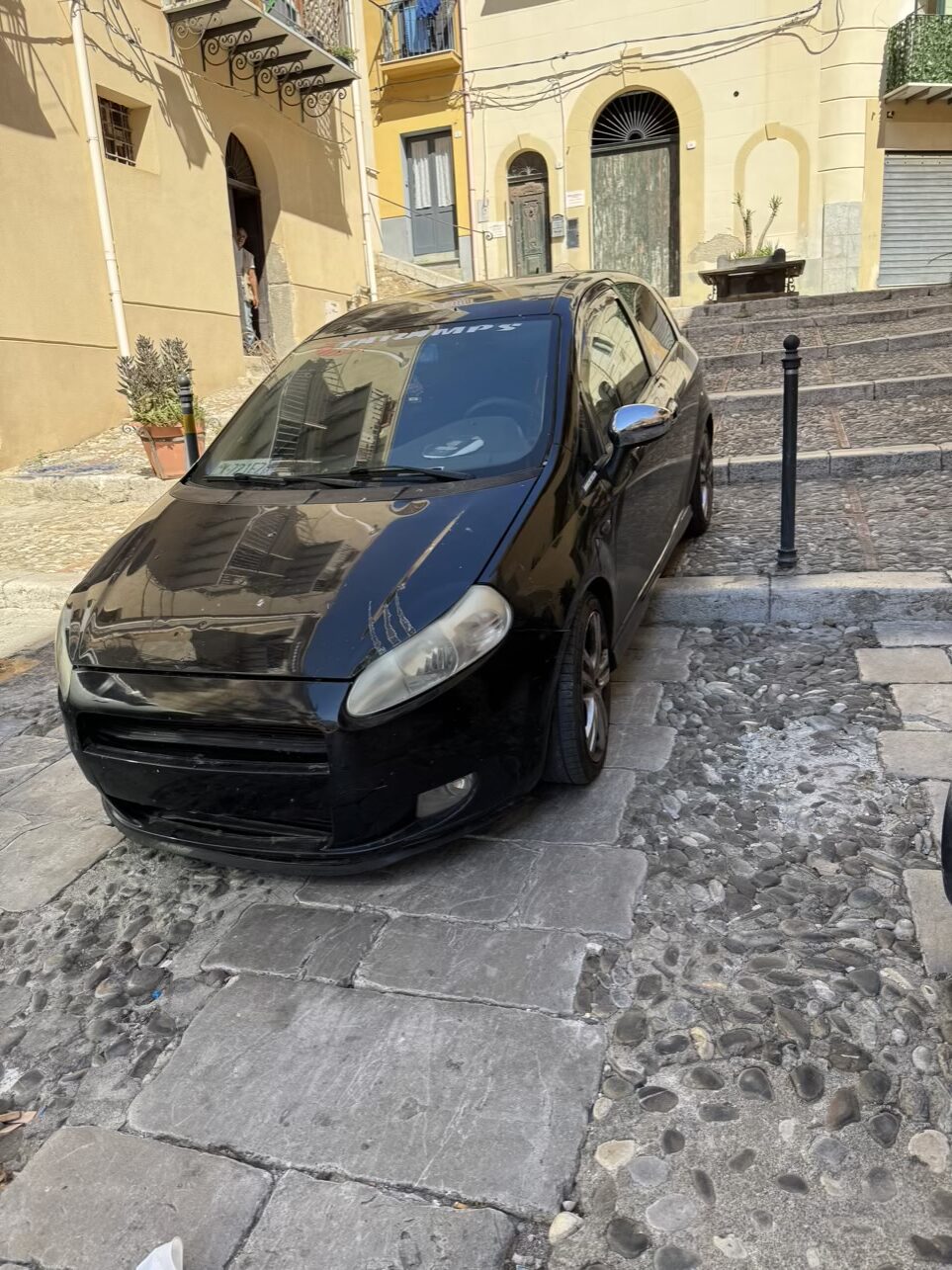
When I first came to the outskirts of Palermo in 2010 all the cars I saw were badly scratched or dented and parked on the road and sidewalk in every kind of configuration. I didn’t want to subject my rental car to this fate so I turned around and went to another place to stay and visit. However, this time I found it to be a safe place to drive and park a rental car, though I didn’t rent one, and things were generally better organized. Palermo is a nice city with many sights and inexpensive street restaurants to enjoy. I highly recommend Palermo.
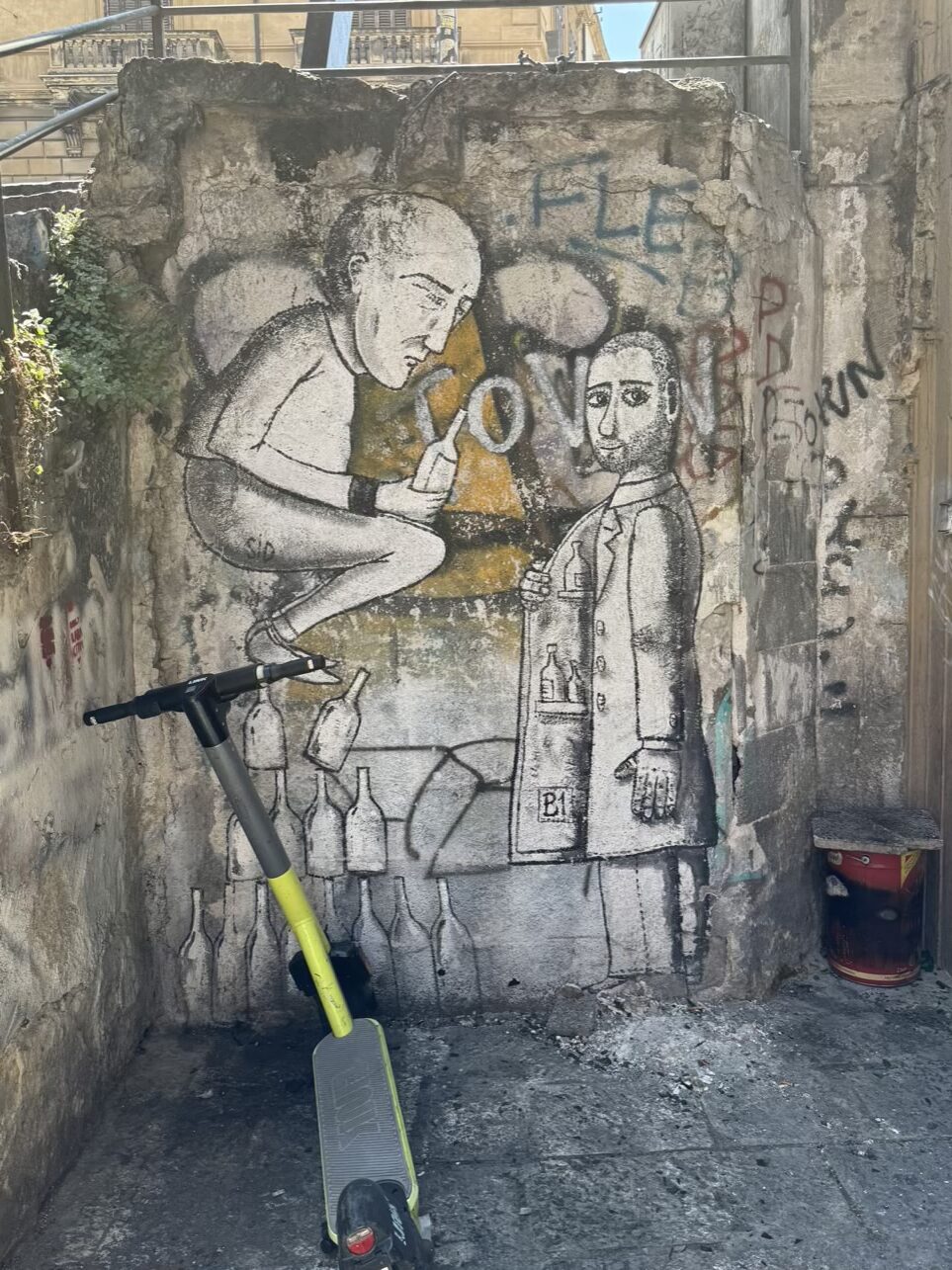
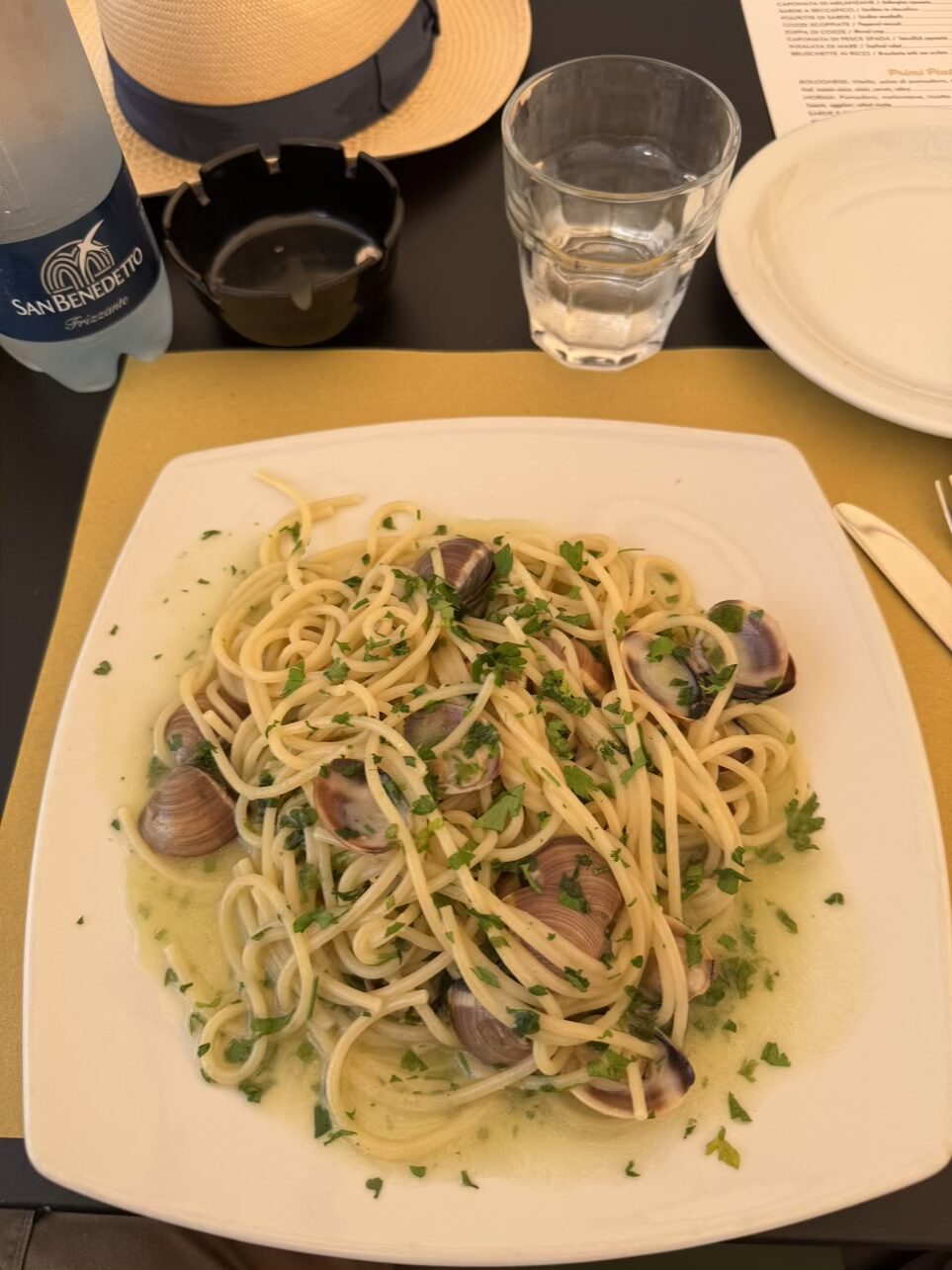
Wonderful spaghetti with musselsStreet art can be a goal of your walk around the citySomething sweet with coffeeDefinitely not run by Japaese, jMaybe by vietamese or chinese Getting dressed up for a wedding reception at the wharf restaurant The portProcessing a big fishAn increasingly popular opinionTypical graffiti Linguine with a nice sauceA very healthy salad with a campari spritzFollowing the band to the celebrationThe celebration posterThe religious celebratin
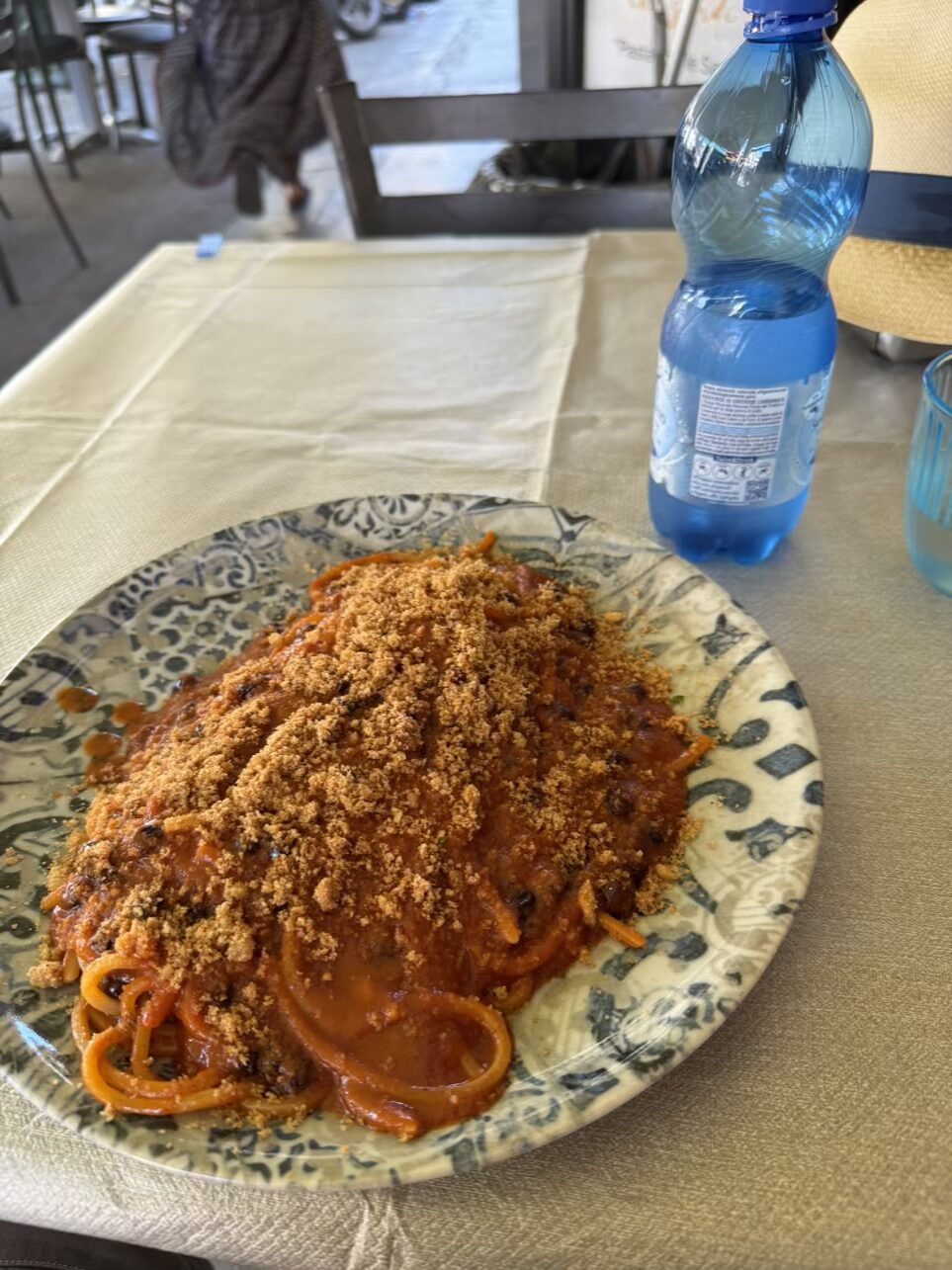
Some people still park anywhereA view at Termini ImereseBike shop fixing the. Young boy’s bikeThis spaghetti sauce was not too richThe young boy was spidermanJapanese characters are popular
Sicily is known for “the Mafia”. I read the term “Mafia” came from Garibaldi in the 1860`s when he entered Sicily near Marsala. He saw these fighters not happy with the unification with Italy in a cave who were ferocious fighters. The term means “bold men”. That was the story anyway. Do some more walking around Palermo and you will find the Anti-Mafia memorial. It highlights the famous bandit Giuliano who, according to the son of Conte Federico, kidnapped his father and grandfather, returning the 4 year old father in 4 days and keeping the grandfather, the current Conte Federico for a few months for ransom which was paid. Now the anti-mafia movement is so strong young people feel they are able to manage businesses without interference from gangsters. There are now so many tourists in Palermo there seems to be no indication of safety issues. I feel more safe here than in San Francisco.
These are the brave people who worked to rid Italians of the MafiaThe bandit Giuliano proposed to President Roosevelt making Sicily a US state. This is the translator’s`s summary of the proposal.People carrying caskets of those murdered by Giulianoworking conditions in mines operated by gangstersNarrow local streetsinteresting facadeBeautiful buildingSicily cathedralCathedral frontLyceum of the previous King. I could not enter, told it was fullIt means *sanitary”
The following are on a wall celebrating the brave people who opposed the Mafia.
An old kioskIt was a tobacco kioskPalermo theaterSome local attractions Do you recognize this actress? Hint: “roman holiday”a very delicious pasta lunchturtles in the pondThe ancient temple in PalermoInteresting to see the Jewish candelabraEtruscan urnAn information plaque on an outside wallThe massive post and telegraph office. We know where the money was.Limoncello is the italian specialty. It is often offered to “preferred” customers at restaurants after the meal. I was offered 2 times.
the Palermo Royal Palace is definitely a “must see” place in the city. You should make time to spend a couple hours there. There might be a different exhibit going on when you visit. I noticed that in many of the palaces which were given up by the owners for financial reasons have been turned into exhibition places, a great chance for the public to see all different kinds of interesting things.
MATERIALS. wood, metal, leather, textiles (among them velvet and damask), stucco, gold and silver foil. On April 3r’, 1766 the Golden Carriage of the Prince of Butera, 1st Peer of the Kingdom of Sicily, opens the sumptuous procession of the 120 Peers of the Kingdom, for the inauguration of the oldest Parliament in the world. The carriage, on the occasion of the “gallery with dance party” organized in the halls of the Royal Palace, parades through the city streets. In the 19th century its restoration is commissioned by Pietro Lanza e Branciforte, Prince of Trabia and of Butera; it is then abandoned, dismantled and stored in the Palazzo Butera warehouses. In 1952 it is reassembled by the production of Panaria Film on the occasion of the realization of the film “La Carrozza d’Oro” (“The Golden Carriage”) by Jean Renoir, with Anna Magnani, a great actress and unsurpassable performer and Rossano Brazzi; the film, produced by the Sicilian film company, is the first ever made in Technicolor. In the same year the carriage, taken to the Venice Festival, is used by Anna Magnani to inaugurate the event, giving great European and international visibility to the city of Palermo. The Carriage was never placed in and exhibited in a city museum. In 1968 the Golden Carriage is purchased, according to the wish of then President of the Sicilian Regional Assembly Rosario Lanza, from a group of antique dealers, who had previously bought it from the heirs of Pietro Lanza e Branciforte.
this reminded me of the large Bodie trees in India and Southeast Asia.Palermo Royal Palace Garden
The urban fortifications underneath the Duke of Montalto Halls. The huge defensive structures, visible here, were discovered in 1984 during an emergency intervention carried out by the Superintendence fe Archaeology of Palermo, under the direction of Rosalia Camerate Scovazzo. They pertain to three different phases concerning the fortifications o Palermo and include a gate to the town connecting the urban road network to the peri-urban territory and, in ancient times, to the area where the necropolis stood. This extraordinary concentration of defensive works can be explained by the fact that this area was of great importance in the control of Palermo as it was the most exposed and accessible side compared to the other sides protected by the rivers Kemonia and Papireto The oldest fortifications were built using a very regular technique of carefully squared blocks, and placed without the use of mortar. Along them is the town gate, 5.18 m wide, flanked by two towers, and a poster, 0.90 m wide, flanked by a small tower. They are a segment of the Punic Panormos fortifications, dating back, according to some scholars, to the middle of the V century B.C., or to the IV/III century according to some others comparing it to the walls of Selinunte’s first Hellenistic age Later, the defences were strengthened through the construction of a new wall, leant over the previous one and made of big irregular blocks (up to 1.80 m), placed, as in the previous case, without the use of mortar and stuffed with stones. The town gate was made smaller (2.50 m) and covered by an arch; the postern was closed. These works have been dated back to the first half of the Ill century B.C., that is, during the decades preceding the First Punic war (264-241 B.C.) and they are explained by the need to adapt the town defences to the new siege techniques and to the use of war machines. These new walls protected the town for a long time, until the Islamic age; according to some scholars this town gate can be identified as one of Balarm’s gates the Arab geographers talk about, the Bab Ibn Qurhub (Gate of Ibn Qurhub) or the Bãb al-Riyad (Gate to the Gardens). During the late Islamic age or during the Norman age, between the late XI and the first half of the XII century, major transformations were carried out: the gate was closed, so modifying the access routes into the town, and a new defensive line was built running parallel with the previous ones, to which it was connected through some section walls, probably counterforts. The new fortifications were made of medium sized ashlars cemented by abundant lime mortar. Elena Pezzini
a decorated cart probably for ceremonies I just found this painting very interestingThe Royal entrance
The King Roger’s Hall is a rectangular hall covered with a cross vault supported by arcs and marble pillars, with re-used Corinthian capitals. There were originally two double lancet windows on the east side and three lancet windows on the north side. Using high 3D technol-ogy, recent studies confirmed this plan. All the walls are covered by white marble slabs, with a frame in the middle, and gold ground mosaics on the top. The mosaics may be contemporary with the ones from the Palatine Chapel, but they represent pagan themes without any reference to Christian allegories. The mosaics all represent the Genoard, the Zisa’s big garden, full of trees, animals, and hunting scenes. At the centre of the vault there is an eagle, symbol of power and nobility, killing with its claws a rabbit, symbol of cowardice. All these images are inspired by middle-east models. The floor was replaced manyfold times through the centuries, but it contains some original parts in porphyry. It is difficult to conjecture how it originally was used: the room was built by the first Norman king, Roger II, and it may have been destined for his leisure activities or as a bedroom or dining room. G.B. Scaduto Traduzione a cura di Giulia Rullo e Paola Torre
Ceiling decorations The skylight The Chinese room Sterilized calligraphy I was told by the future conte Federico that the eagle is from German heritage
The Pisan Tower is to be considered as the core of the Norman power within the Royal Palace, and the manifesto of the monarchs’ political success in the town. The tower considerable size is probably due to the fact that it served as a donjon, a military role it played from the Norman period to the times when it was called “turri mastra” (master tower) by the architect Ferramolino in the XVI century. The Pisan Tower was probably built under the reign of Roger II of Hauteville, and definitely before the construction of the Palatine Chapel. Its “double shell” structure was inspired by some northern Africa buildings like the XI century Qasr al-Manãr at the Qal’a of Beni Hammad. Inside, the Pisan Tower central room, more than 15 meters high, with its large window and its surmounting porthole, inspired deference in those who went to meet the king. In fact, the mosaics covering the walls (of which only some fragments full of gaps remain today) narrated of battles glorifying the Hautevilles and the king. This repertory of figures was supplemented by phytomorphic elements, which can be compared with others in Roger Il’s Hall. It is probable that, at the time of Frederick II, in this solemn place, used as throne room by the Norman and Swabian kings, where Eastern and Western Mediterranean cultures met, important verses were written which contributed to the spreading of the Italian language through the Sicilian School of Poetry.
The dining hall This is obviously used for a community official meeting room
The Norman and Swabian pottery. Norman pottery in Sicily is linked to the Islamic age production, their common features being, for example, the technique used or the persistence of some shapes. The similarities between the artefacts of the two periods show that the Muslim potters still worked even under the Norman rule, and as a consequence, the knowledge and expertise of the Islamic artisanal tradition were handed down to the pottery production of the following age; but, compared to the variety of the Islamic age, the shapes and decorations were simpler. Between the late XI and the early XII century A.D., the typical shape is a deep hemispherical glazed bowl with a short brim’s edge that, according to some scholars, was already produced during the Islamic age, between the late X and the first half of the XI century A.D., alongside the more numerous open and carinated shapes. These vases show a transparent or green glaze of modest quality, and few brown elements; or they are colourless, with or without a surface discolouration. During the Norman age the bowls sides and brims get thicker and thicker and they show a recurring decoration, a plait or leaf pattern. Moreover, during the late Norman age, there is a production of green glazes with a furrow decoration performed before the firing. The. spreading of this kind of products over various areas, mainly along the. Tyrrhenian coasts, is supported by documentary evidence. In Sicily, the connections with the Byzantine Empire are attested by the rare presence of yellow, on engobe, glazed pottery, with a graffiti decoration. Starting from the late XII century A.D. and during the first three quarters of the XIII, brown and green pottery decorated with spirals arrives from Campania, later imitated by the Sicilian potters whose products only show green decorations. From Tunisia comes the “cobalt and manganese” pottery, painted in brown and blue over a white enamel, and from Liguria comes the so-called “graffita arcaica tirrenica” pottery. Carla Aleo Nero, Monica Chiovaro
Beautiful ceiling Three styles of carriages at the Palermo Royal PalaceThe foundation to preserve this palace is named after the Norman Kings
Palermo’s fortifications. during the Norman-Swabian age. On January 10, 1072 the Normans, after a six-month siege, conquered Madinat Sigilliya. The conquest accounts seem to indicate that «high walls» closed in a single defensive line the whole town perimeter and that a further defence were Balarm’s huge fortifications. Yet, some scholars date Palermo’s wide outer walls circumference to the Norman age. However, Norman Palermo had a complex fortified system that was the result of various interventions and which was made up of several defensive structures: a wide surrounding outer wall; Balarm’s walls that kept their defensive function and helped maintain the control over the territory and that had also a function of internal barrage in a town where conflicts were common; a further fortified area within Balarm, called Galka, probably the Norman kings’ palatine town; two castles, the Castrum superius, corresponding to the Royal Palace, and the Castrum inferius or Castello a Mare. The large outer town wall surrounded the whole urban area, which included Panormos-Balarm, called al-Qasr (the “castle”, “palace” or “fortress”) al-qadim (old”), and what the Norman age writers call the village, corresponding to the Khãlisa and to some quarters that developed during the Islamic age. The external wall measured little less than it measured in 1493 when it was «Surrounded […] by a string […] and it measured 3,253 canne» (that is 6.5 kms). In fact, it underwent several reconstructions, but its course was not changed, until the XVI century A.D. We know from al-Idrisi’s Book of Roger. (1154), that the town walls were «equipped with a wall, a moat and a shelter», and so, apart from the high wall, there were a moat and a rampart. Its average height was of 10 metres, it was strengthened by towers and along it opened at least 10 gates, placed where the main road axes were. The wall remains belong to different periods. Those ascribed to the Norman age seem to have been built with a double face made up of small squared blocks, bound by lime mortar and stuffed with shapeless stones and lime mortar and they are a little more than 2 metres thick. In the course of the centuries, the outer wall underwent important restoration works, the curtains were repaired and new towers were built. The wall made up of small blocks bound by lime mortar preserved in the archaeological area of the Royal Palace (stage Ill) has been related to the construction of the outer wall or to the construction of the Normans’ Castle. As it seems, the Swabians did not make any important changes to this fortified system. Traces of interventions dating back to Frederick Il’s age can be located on the so-called Master Tower and on the Castello a Mare. Elena Pezzini
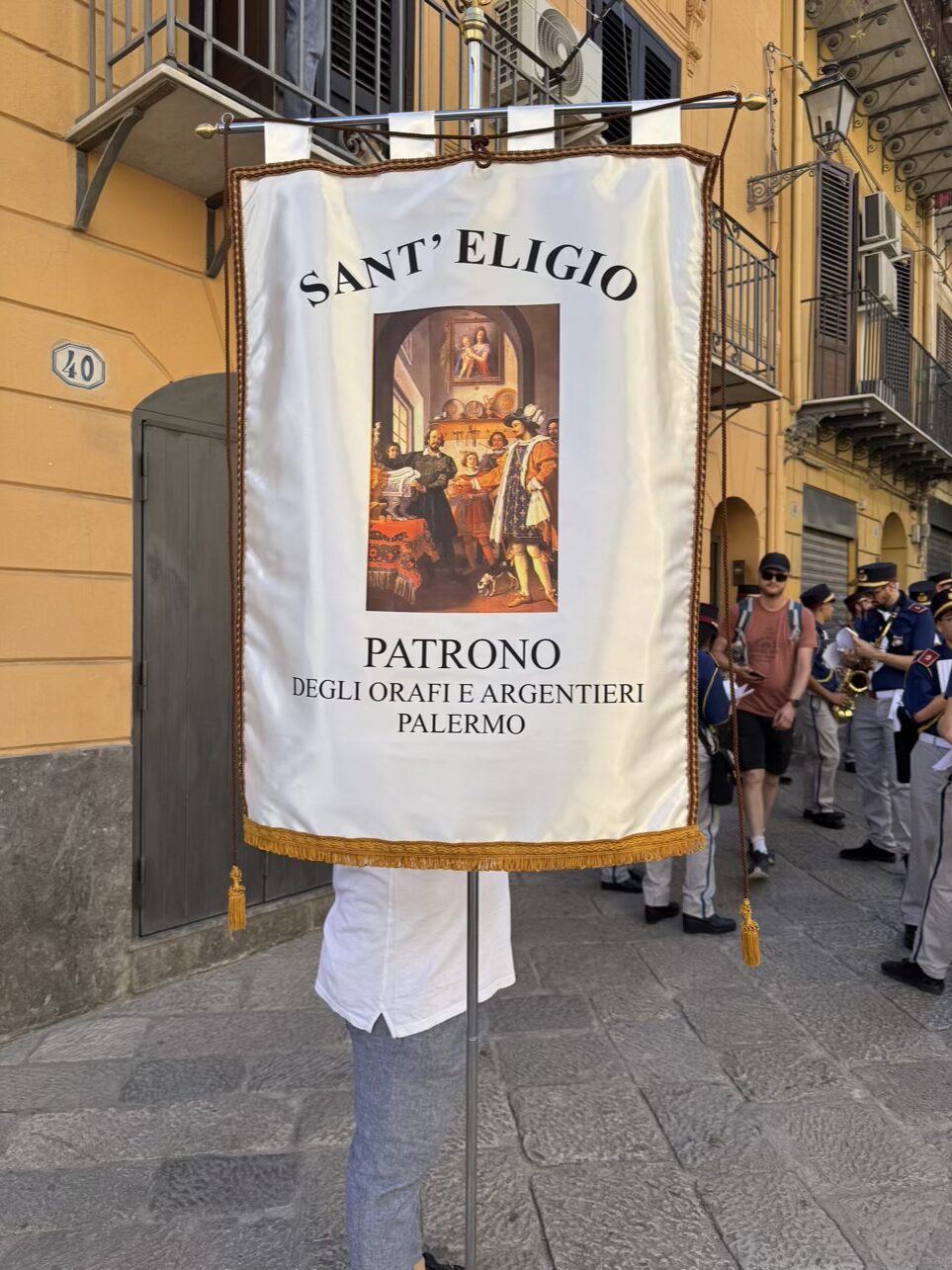
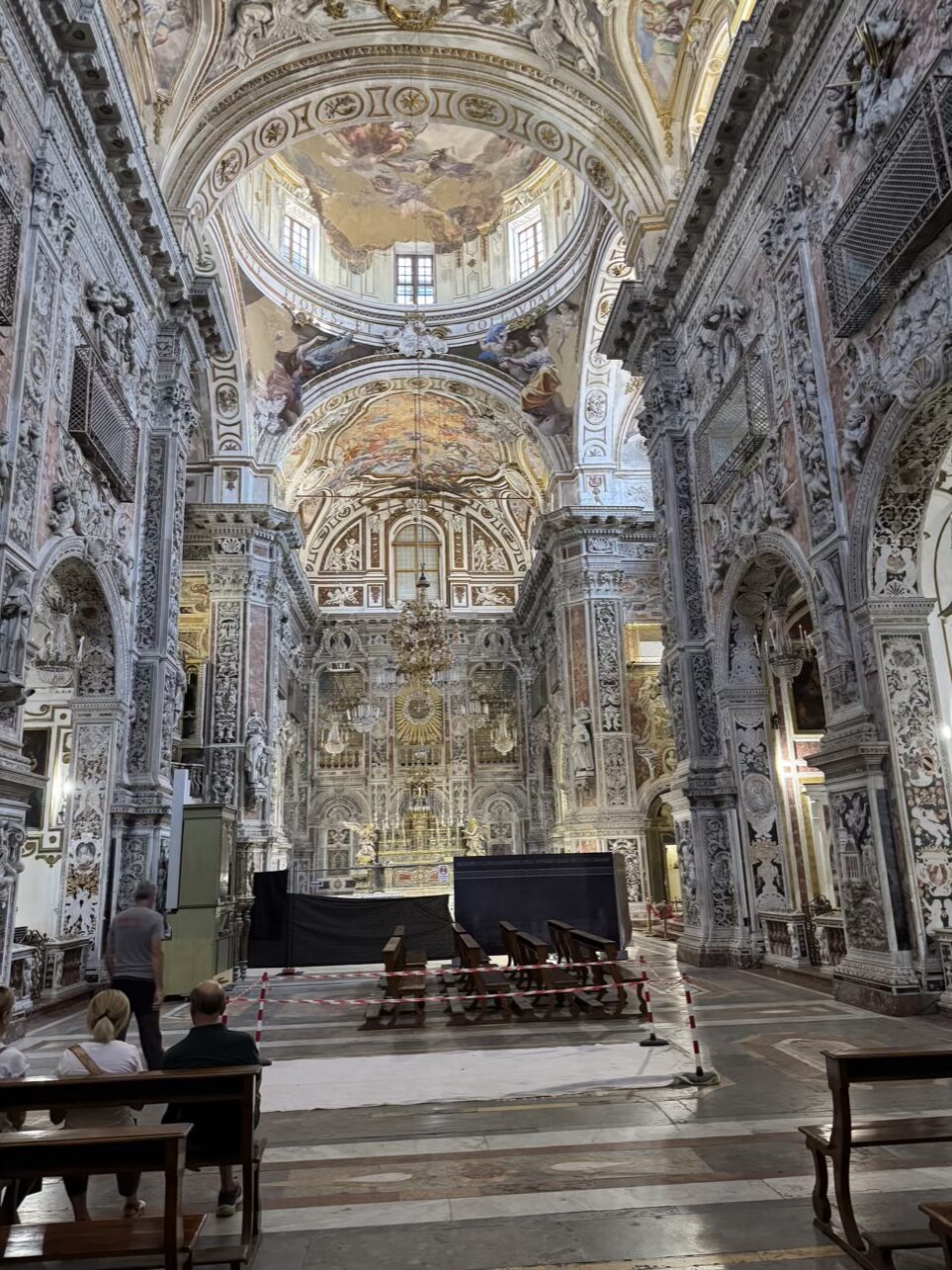
Entrance to the chapel a long line waiting to get into the chapelInside the chapel Chapel ceiling Just to prove I was there Middle courtyard typical of many Italian PalazoDecorated cart The palace entrance were the poster promoting Erwitt photography exhibit Entrance gate
Erwitt what’s famous for his photo of Marilyn Monroe standing over the draft from the air vent below, probably the subway, which blew up her dress. The photo below is not the exact photo that’s famous but it shows a little bit more action than the more famous one. It was interesting to see his exhibition in the Palermo Royal Palace.
There is another more famous photo of Nixon talking with Khrushchev over some kitchen related equipment and dubbed the “kitchen debate”. This photo I don’t specifically remember. of course you recognize HitchcockThe last movie for Clark Gable and I think also for Marilyn MonroeThis photo I remember will Who is driving? Is it the lion?Andy WarholTypically French in the 1950sThe lady is not impressed Twins? The leap of faith? The most modern of art? Where is the beef? Where is the painting? Where’s the …. anything?
What amazed me about the city is when you’re walking around Palermo you see a lot of things that you probably don’t expect to see. Sicily has been left behind economically in comparison to other places in Italy and the tourism has not been that robust. But I see a big change in that and a great improvement and many new building projects and renovations going on. You will see some poorer parts of the city right next to a newly renovated and beautiful church or a very nicely decorated Trattoria or bar. This is a great city to walk around and to just go around the backstreet to see what you can find. You need at least three days in the center to start to see some of the interesting attractions. Here are some of them.
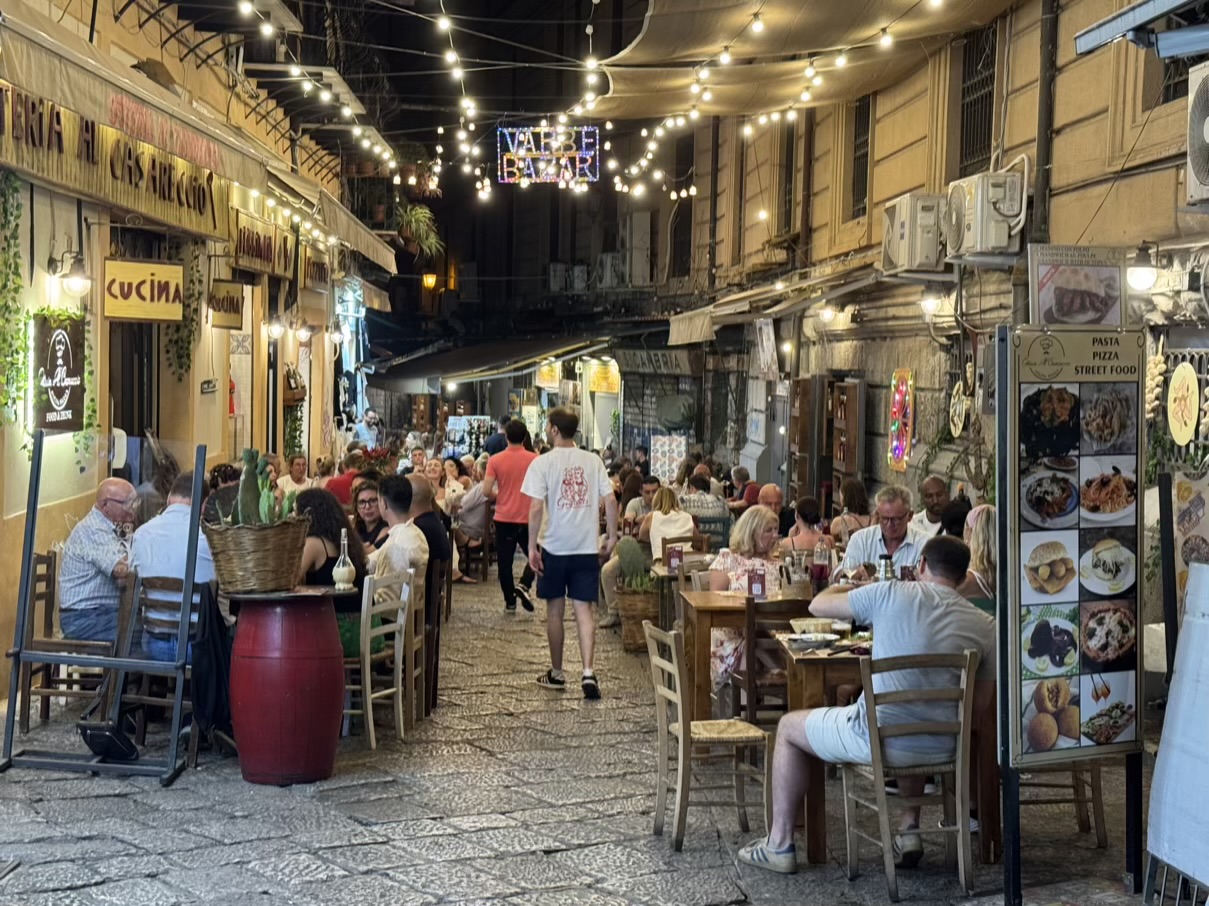
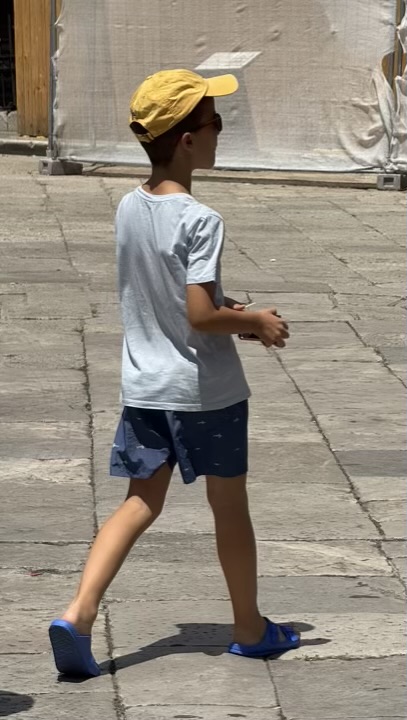
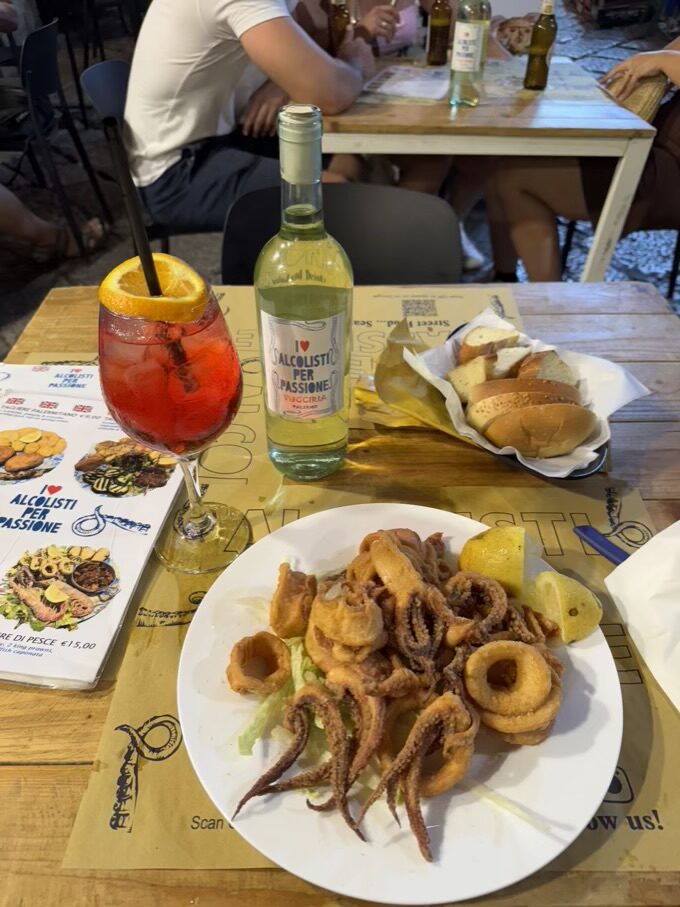
This is a statue being renovated at the Royal Palace a back alley restaurant with food already prepared. This is a Sicilian eggplant dish and a Limoncello with very fresh bread. The people sitting next to me were from England and we had an interesting discussion. This looks like a duk duk but the driver was playing Randy Travis country music which I found refreshing.The New gate Some well-known fellow who is dressed like a medieval Viking but it seems it might be King Philip the fifth of SpainHis crest One of the interesting Piazza with a few churches of Norman and Arabic architecture. I took a shot when the Carabinieri (national police) were driving through.Santa Catarina ChurchA good picture menu I went to a local café and they had homemade deep-fried rice balls with other stuff inside. It was a good little breakfast Street Art very close to my apartment Not much much thickness to the topping but very tasty and the crust was crunchy so deliciousThis narrow alleyway is where I often eat, near the apartment A small Piazza near my apartment These pathways became roads hundreds of years after the buildings had a foundationThis spaghetti vongole which delicious. It had a buttery tasteThis kid with the sunglasses just looked like a mover and shakerGood prices and the food is pretty goodYou can find better food somewhere in the city but for the price performance and the closeness to the apartment this has been a good choice and they are serving me well as a repeat customer Calamari with a Campari spritzI don’t think this place is open anymore. I would’ve liked to at least look at the menu Walking around Palermo I found this is my favorite café with different kinds of morning bread with coffee. I usually order café Lungo which means “long coffee”. So it’s just espresso with a little more water.This is a café LungoThe different pastry offerings at my coffee shopThis is a statue in front of the church at Piazza San DomenicoThis is a church in this Piazza which is getting a new façade it seems Trying to look more distinguished with face hair. I wonder if I will get more respect?
The cooking this restaurant is Japanese. The food was just like eating in Japan, good flavors. We met a retired Plantology professor in Freising. He was born in Ireland but moved to Germany more than 30 years ago. He enjoyed drinking wine at the lunch. He was also very good Guide around this old and historical city At a dinner with friends from Garda and VeronaOur dinner friends included to sommelier and this is the wine they chose. Very delicious. A little overcooked around the edges but delicious 4 cheese Just something for breakfast. The one on the right had pistachios on top This restaurants FAGIOLIThis was at a restaurant out-of-the-way, newly opened and really delicious food . Bar Fuoricorso. Go here and try the food.We had the second and fourth one from the top